Why an AI PR toolkit is becoming essential
PR has always come down to the same few things. Finding an angle worth covering, working out which journalists care about it, and getting it in front of them before someone else does.
The work has not changed. But the speed PR moves at has.
Stories move faster, more people are pitching the same angles, and the people keeping up are the ones that have wired AI into their actual workflow rather than just using it to write draft pitches.
An AI PR toolkit will help you make every part of your workflow more efficient. And with more time, you can act on more opportunities, send out more pitches, and ultimately get more coverage.
JournoFinder as an AI PR toolkit
JournoFinder is the most complete AI PR toolkit for modern public relations teams. Most PR tools handle one job well and leave you to bridge the gaps. JournoFinder covers the whole PR sequence from working out what to pitch through to finding the people to pitch it to.
The key parts of JournoFinder’s PR toolkit are:
- Ideation: Query 3M previously successful PR campaigns for potential angles.
- Reactive: Breaking news and journalist requests alerts, filtered to your client.
- Verified contacts: A fully maintained journalist database verified in real time.
- Discovery: AI-enhanced searches for discovering the most relevant contacts.
- AI Agent: An AI Agent that is trained to use the database to build targeted media lists.
There are two ways to use JournoFinder.
JournoFinder runs as an MCP server. This means you can connect it to an AI tool of your choice such as Claude or ChatGPT, and all the tools become available right in your chat.
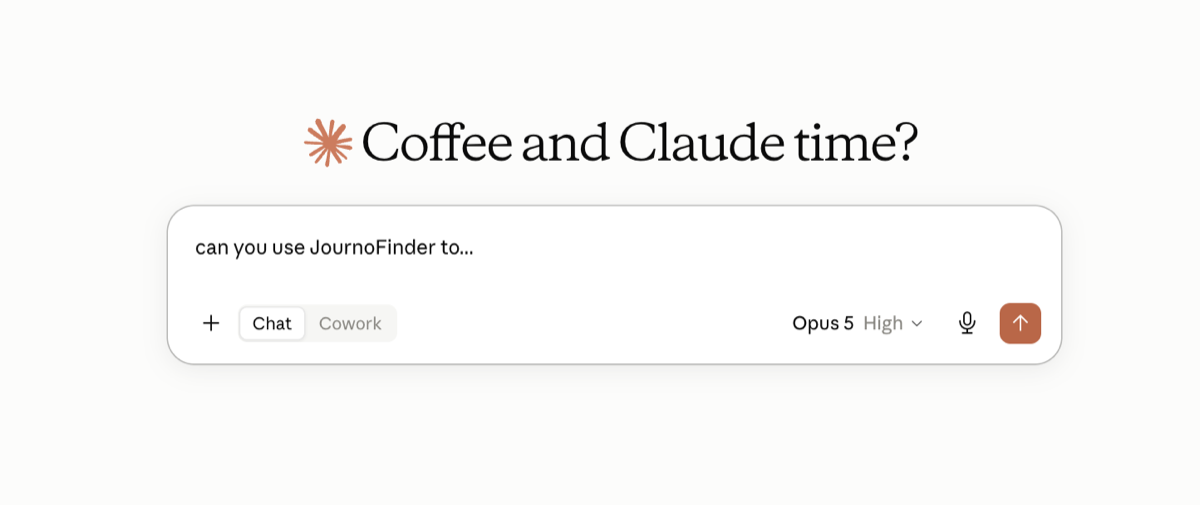
Or you can stay in-app and use the JournoFinder Assistant to run your workflows.
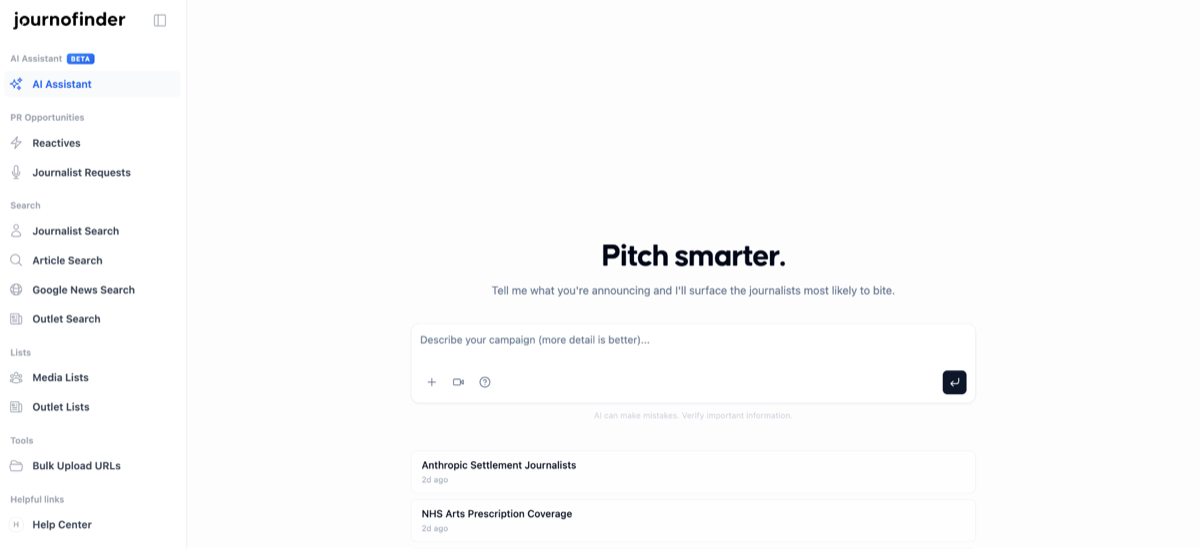
While JournoFinder is AI native, the AI is never forced on you. You can still build a list yourself manually using the search capabilities if you prefer.
Using a chatbot vs a dedicated AI PR toolkit
The difference here is what your tool has to work with.
A chatbot draws on training data and whatever it can find on the open web. That gets you the journalists who are easy to find, at the outlets everybody already knows, writing public bylines.
Good PR AI tools run on a database that is built and maintained for the job. JournoFinder holds its own constantly updating journalist data with full article history for each person, as well as its own record of PR campaigns, kept current rather than assembled fresh each time you ask.
That shows up in two ways.
Reliability. Open web data goes stale quietly. A journalist moves outlet and the old articles stay up, so a chatbot will keep offering you a contact who left six months ago, with no signal that anything is wrong.
Depth. A chatbot returns what looks right on the surface, which is usually the top twenty names on a subject. It will miss things like smaller outlets that don’t show up on Google and editors that don’t have bylined articles.
The same applies to ideas. Ask a chatbot for a campaign angle and you get the obvious ones, because the obvious ones are what the training data is full of. Ask against a record of campaigns that actually ran and you get the less obvious ones that worked.
What does an AI PR toolkit need to include?
A PR Toolkit needs different components to help you with every step of the PR process, ideally with a way to connect them so the end-to-end sequence has the ability to run automatically.
JournoFinder has tools to help you with ideation, opportunity spotting, and list building.
Using AI for PR ideation
The hardest part of a campaign is working out what to run.
You could use a general chatbot for this, but you will just get the most obvious answers.
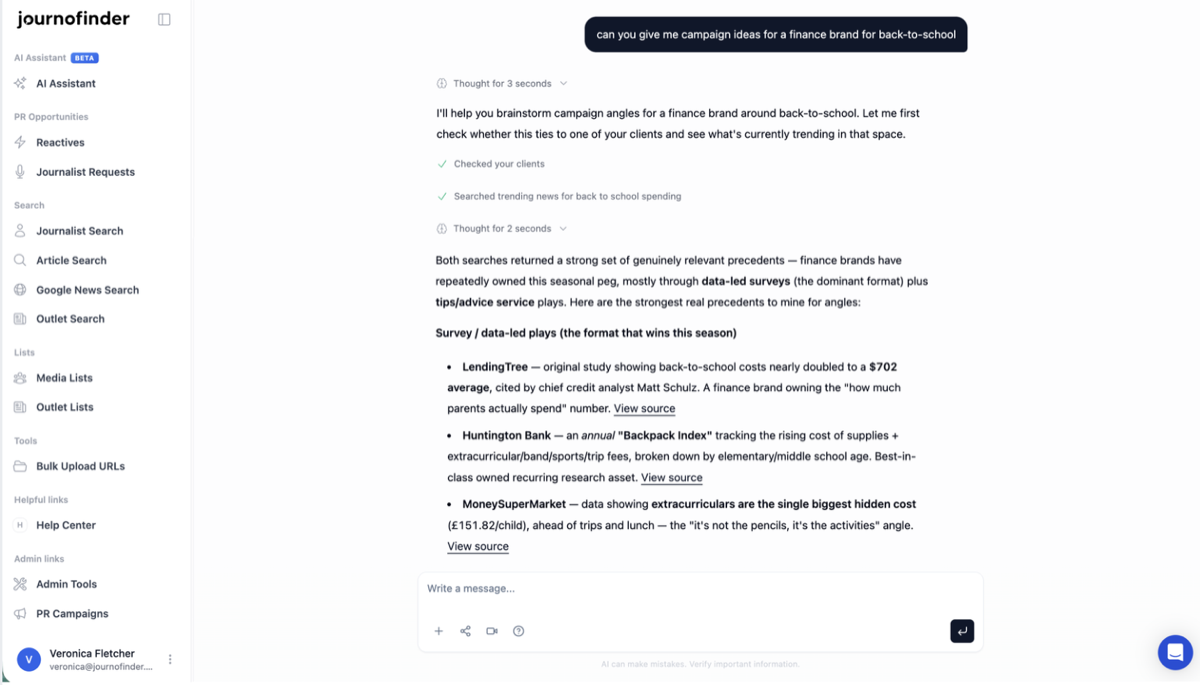
JournoFinder’s Agent answers ideation questions from a dataset of over 3 million previously successful PR campaigns, indexed by brand, spokesperson, the news event behind the campaign and the sector the client was in.
Ask JournoFinder for campaign ideas for a finance brand for back-to-school and you get things that actually worked for finance brands before.
Using AI for spotting PR opportunities
Reactive opportunities are often the easiest way to get coverage - so it’s important that a PR toolkit has a way of finding these for you.
JournoFinder monitors the news as it breaks and matches emerging stories to your brands or clients, so you are alerted as soon as a relevant opportunity appears.
JournoFinder also pulls journalist requests in real time and can send alerts for these too.
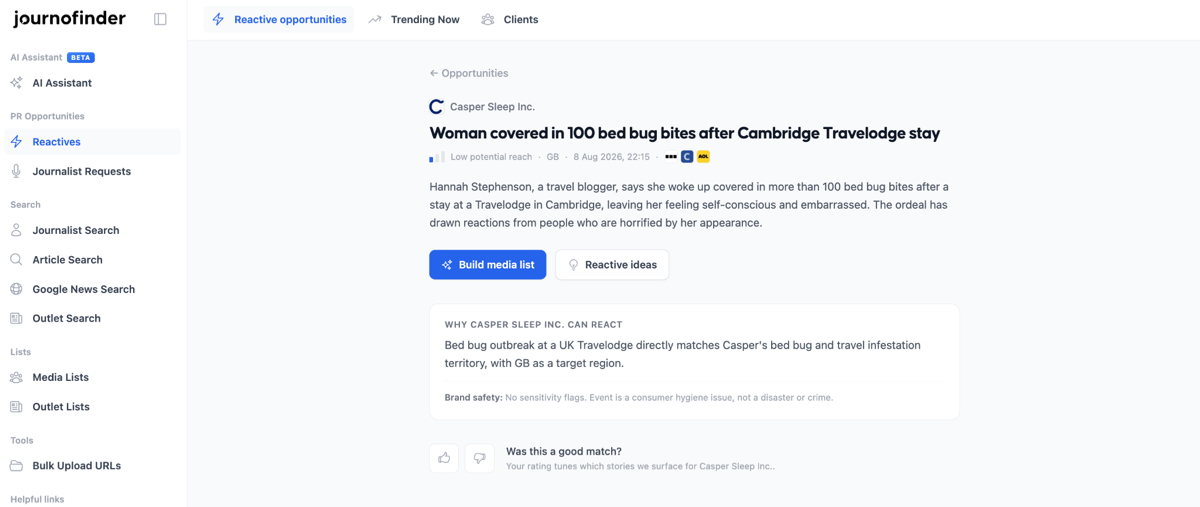
Once you have the alert, you can use JournoFinder’s other tools to work on the next steps of the process. You can use the ideation tool to come up with reactive campaign ideas.
And the list building tools to create a list of journalists who will be covering the story.
Using AI for media list building
This is where most PR time disappears. You have an angle, but you need the journalists who cover that subject, at outlets worth being in, with addresses that still work.
JournoFinder approaches this two ways.
You can search the database directly, or hand your brief to JournoFinder’s AI Agent and have it build and refine the list for you.
You can also get the Agent to run deep dives on individual journalists to double check the match before anything goes out.
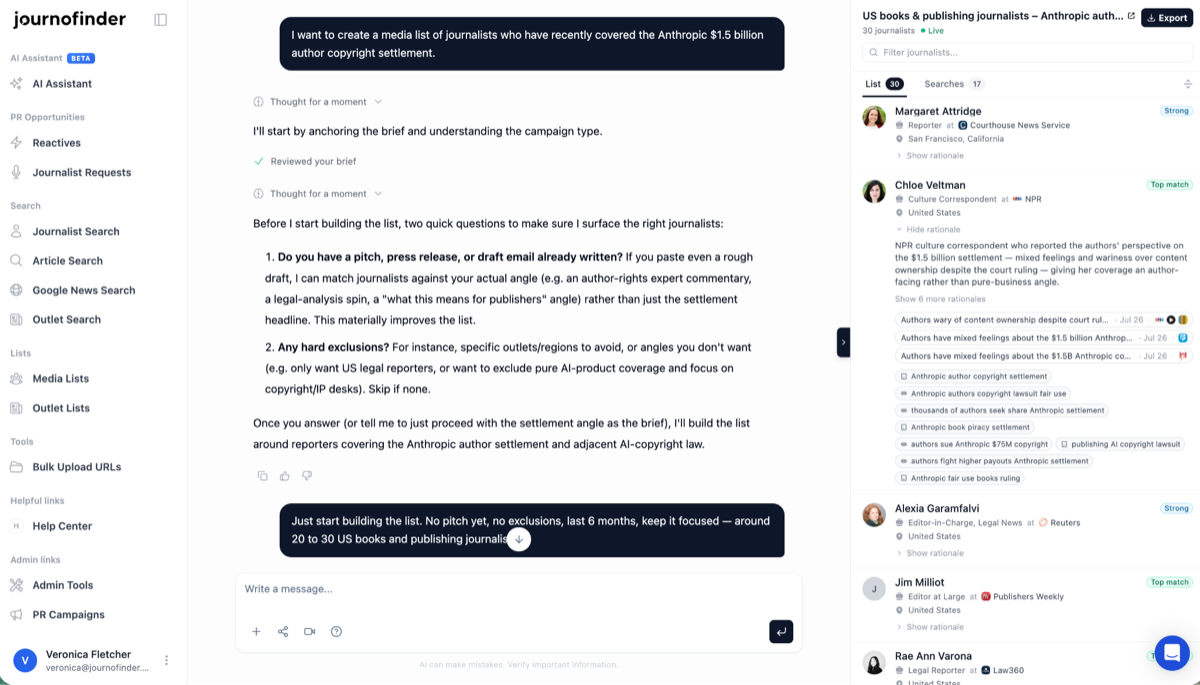
The Agent is trained on using JournoFinder’s search capabilities, which are set up to be super efficient at finding relevant journalists. They include a semantic topic based search, as well as a live Google News search.
This is the part that really lives and dies on the data your toolkit is working with. A PR toolkit with limited data or that only searched the web is going to return a thin, low quality list.
Integrating an AI PR Toolkit into your current workflow
Most PR tools expect you to work inside them. A toolkit works the other way round, where the tools are available to integrate into whatever workflow you already use.
JournoFinder runs as an MCP server, which means the JournoFinder tools get added into whatever you already use rather than replacing it.
The simplest version of this is connecting JournoFinder to Claude or ChatGPT. The JournoFinder tools then become available in the chat interface, so you can research an angle, build a media list, and check individual journalists in one conversation.
Every step runs against JournoFinder’s own journalist database rather than the open web, which means the answers come from maintained records instead of whatever the model can find.
But a chat window is only one place an MCP can plug into.
The same connection works in coding agents like Claude Code or Cursor, in automation platforms like n8n and Zapier, or in custom agents built with an SDK - anything that speaks MCP can use JournoFinders tools.
From there people build their own things.
- Reactive agents that watch a client’s sector and come back with an angle and reporters
- Internal dashboards and pitch trackers running on the same underlying data
- Weekly opportunity briefs assembled per account, on a schedule
- Existing workflows extended, rather than replaced with someone else’s
The reason this works is that the hard part is already done. Building a journalist database, keeping it current, and indexing millions of articles is years of work, and it’s not what an agency should be spending time on.
You build the layer that is specific to how you work, on top of data that holds up.
What is the best AI tool to find podcasts?
Rephonic is the best AI tool for finding podcasts to pitch. It indexes over 3 million shows with listener estimates, audience demographics and host contact details, so you can judge whether a show is worth pitching before you write a word.
For podcast outreach, pair it with JournoFinder: Rephonic finds the shows and their hosts, and JournoFinder handles the angle and the press list. Both run as MCPs, so they work side by side in the same chat.
Tools you use every day probably have MCPs too - Gmail, Google Sheets, and Slack for example.
Put your whole PR sequence in one place with JournoFinder
3 million past campaigns for angles, a verified journalist database, an agent that turns a brief into a media list, and instant reactive alerts.
Common questions
What is an AI PR toolkit?
An AI PR toolkit is a set of connected tools that let AI handle the research and outreach parts of PR. It usually covers ideation, spotting reactive opportunities, building media lists and sending pitches, with the pieces joined so the sequence can run end to end.
What parts of PR should remain human-led?
Judgement and relationships. Deciding whether an angle is actually worth pitching, building rapport with reporters, handling anything sensitive, and the final read of anything going out under your name. Ideation is worth keeping a hand in too, since AI works from what has already run and people come up with the ideas that have not.
What parts of PR should teams automate first?
Data collection, reactive news ingestion and pitch writing. These are the high volume, low judgement parts, where the work is gathering and drafting rather than deciding. You still read the output before it goes anywhere, so a bad draft costs you a minute instead of a relationship.
What is the best AI tool to find podcasts?
Rephonic. It indexes over 3 million podcasts with listener estimates, audience demographics and host contact details, so you can judge whether a show is worth pitching before you write a word. It runs as an MCP, so it works alongside JournoFinder in the same chat for podcast and press outreach together.
Do I need to be technical to use an AI PR toolkit?
No. JournoFinder works as a normal web app, so you can search the database, build lists and read your alerts without touching anything technical. Connecting it to Claude or ChatGPT takes a few minutes of setup, and building your own agents on top is optional rather than the point of it.